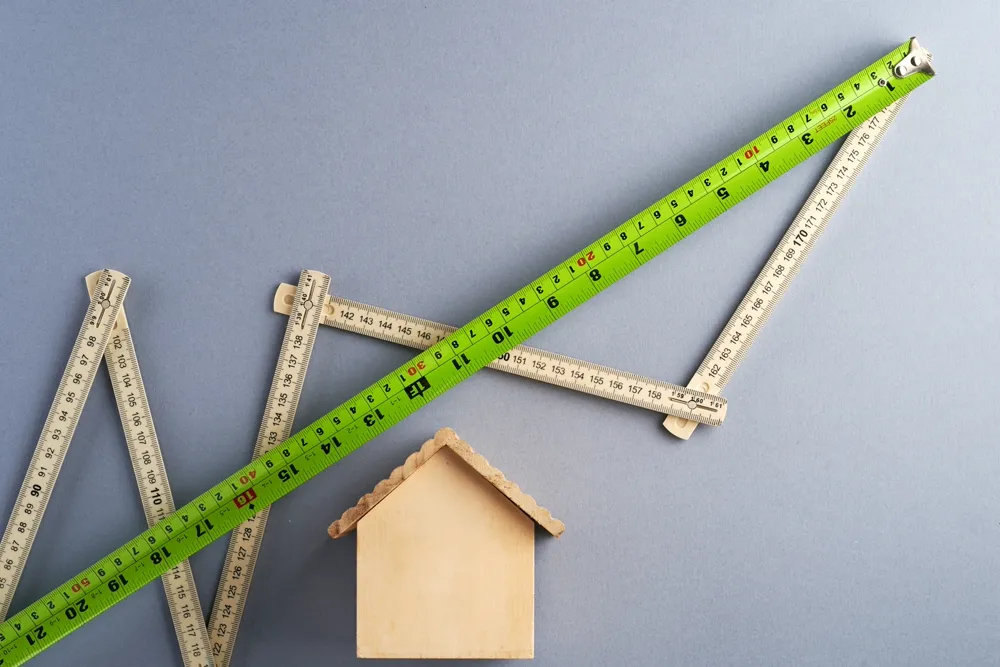
You’re hanging a picture frame, and the nail hole needs to be exactly 14 inches from the corner. Or maybe you’re buying a rug online and need to know if it’ll fit that awkward gap between your couch and the wall. Either way, you look around for a ruler or tape measure, and there’s nothing in sight.
Good news: you don’t actually need one. People measured things long before rulers were common household items, and most of those old tricks still work today.
Use Your Own Body First
Your body is a measuring tool you always carry around. It’s not going to be perfect, but for most everyday jobs, it’s more than close enough.
Your Hand and Fingers
Stretch your hand out flat, thumb to pinky. For most adults, that spread is somewhere between 7 and 9 inches. Measure yours once with an actual ruler (borrow one, or check a phone) and write the number down somewhere you’ll remember it. After that, you’ve got a built-in measuring tool for life.
A single finger width is also handy for small measurements. The average adult finger is close to an inch across at the widest point, which makes it useful for eyeballing small gaps or checking rough sizes.
Your Foot
This one’s almost too obvious, but it works. Line your foot up heel to toe, and walk forward, marking where the toe of each step ends. Most adult feet land somewhere between 9.5 and 12 inches, so if you know your shoe size, you can get a rough number without any extra tools at all.
Your Arm Span
Stand with your arms stretched out to the sides. For most people, the distance from fingertip to fingertip is roughly equal to their height. This sounds strange, but it holds up surprisingly well across different body types. It’s a great trick for estimating the width of a room or a piece of furniture from across the space.
Everyday Objects Double as Rulers
Look around your desk or wallet right now. Chances are, something nearby has a known, standard size.
Paper Money
Bills are printed to an exact size depending on the country, and that size never changes. A US dollar bill, for example, is 6.14 inches long. Lay a few end to end, and you’ve got a makeshift tape measure for anything up to a couple of feet.
Credit Cards and ID Cards
Nearly every card in your wallet – debit cards, driver’s licenses, gym membership cards – follows the same international standard size: 3.37 inches by 2.125 inches. That consistency makes cards genuinely useful for measuring small objects, and it’s a trick photographers and online sellers use all the time to give buyers a sense of scale in product photos.
A Sheet of Paper
Standard printer paper is 8.5 by 11 inches in the US, or 210 by 297 millimeters (A4) in most other countries. Fold it in half, and you get a quick reference for roughly 4 or 5 inches. Fold it again, and you’re down to about 2 inches. It’s not glamorous, but it’s accurate and it’s sitting in every printer tray.
Coins
Coins are minted to strict, unchanging sizes. A US quarter is 24.26 millimeters across. Keep a couple of common coins in mind, and you’ll always have a small, precise reference point in your pocket for tiny measurements, like checking the width of a screw or a gap in a hinge.
Your Phone Is More Useful Than You Think
Smartphones have quietly become decent measuring tools, in more ways than one.
Some phones come with a built-in Measure app that uses the camera to estimate distances in real-world space. It works by tracking depth and motion, and while it’s not lab-accurate, it’s usually close enough for furniture shopping or checking if a doorway is wide enough for that new couch.
There’s also a simpler option that doesn’t need any app download or camera permissions at all: measuring directly on your screen. Sites like onlineruler.in turn your phone or laptop screen into a calibrated ruler, in centimeters or inches, so you can measure small flat objects just by placing them against the display. It’s a handy backup for those moments when you need a number fast and don’t want to hunt down a physical ruler or dig through app store results.
Measuring Longer Distances
Body parts and pocket items are great for small stuff, but what about a garden bed, a driveway, or a room?
Count Your Steps
Walk heel to toe across the space, counting each step. If you know your average step length (measure it once against a wall for accuracy), multiply that by your step count. It won’t be exact, but it’s close enough for planning purposes, like figuring out how much fencing or flooring to buy.
Grab a String or Rope
This old trick still holds up. Lay a piece of string along the distance you want to measure, mark or cut it to length, then measure the string against something with a known size, like a doorway of a standard height, or fold it against your arm span. It’s slow, but it’s one of the most accurate no-ruler methods around, especially for curved or uneven surfaces where a rigid tool wouldn’t work anyway.
A Few Tips for Better Accuracy
- Measure twice using two different methods, then compare. If your hand-span guess and your coin count roughly agree, you can trust the number more.
- Round generously when it matters. If you’re not sure whether something will fit, assume it needs a little extra room.
- Calibrate your body references once with a real ruler, then reuse those numbers forever. This is the single best thing you can do to make hand and foot measuring reliable.
- For anything that actually needs to be precise, like a home repair or a shipping label, it’s worth tracking down a real ruler or using a screen-based tool for a quick double check.
The Bottom Line
Not having a ruler on hand doesn’t mean you’re stuck guessing. Between your hands, your feet, the cards in your wallet, and the phone in your pocket, you’ve got several backup measuring tools available at any given moment. None of them will replace an actual tape measure for precision work, but for the everyday question of “will this fit,” they’ll get the job done just fine.